Thursday, November 11, 2010

Remember, There's No "Remember" in "Remembrance"

Had our lunch today at the fabled Tomahawk eatery in North Van (fabled for its long waits for a table) and saw this disconnect between signs in the foyer.


"Rememberance" would seem to make sense, but in fact the one on the right gets the spelling correct--as any "vetern" will tell you.

Regardless, our luncheon was the kind of comforting comfort food experience one expects from a visit to the Tomahawk. Lots of greasy belly-stretching entrees and wonderful 1950s-style faux log cabin ambiance. Plus, funky cardboard hats:

Tuesday, November 09, 2010

A Dashing Display of Pucksmanship

Abby has managed to bring home from the school library one of the most checked-out and sought-after items, the picture and rhyme book, Dino-Hockey--a charmingly illustrated story depicting a game between the Meat-Eaters and the Veggiesaurs.

We'd actually gone through a few readings before we were both suddenly bumfuzzled by this page:


At first, Abby was wondering (nay, demanding to know) why the exclamation point wasn't at the end of the sentence. I started to explain how two dashes can set off a parenthetical subordinate clause (and how that clause could have its own exclamation point), when I realized that those dashes were not in fact doing that. That is, if you removed the words between the dashes, the sentence would collapse like a Toronto Maple Leaf defenseman looking down the barrel of a two-on-one.

Still, as a fan of em-dashery, I suggest we keep that first dash and, on Abby's advice, move the exclamation point to the end, giving us: "He knows the game's not over yet--a slap shot headed for the net!"

For the record, Triceratops scored on that late slap shot, giving the Veggiesaurs the win for the Cup.

Monday, November 08, 2010

An Etymology Unmasked

There has been a lot of media hullabaloo about the passenger who boarded an Air Canada flight in Hong Kong as an elderly white man and disembarked in Vancouver as a young Asian guy. Many are shocked that his Mission: Impossible-style silicone mask was able to fool airline staff, but let's face it, most of these grunts are too busy stamping documents, wrestling carry-on into overhead compartments, and telling us to turn off our portable electronic devices to play detective.

The episode inspired the The Vancouver Sun to do one of those silly experiments news outlets like to do, and so a young reporter was dispatched to be made "old" by film special effects wizards and sent out on the streets to see whom he could fool. Practically nobody, as it turned out--an outcome that is foreshadowed early in the first-person report by said intrepid reporter:
If anyone scrutinized me closely the gig would be up, I thought, as you could clearly see my makeup in more detail as well as the fake mustache lining...
Now, the reporter may have had a gig, in the broadest sense of "a booking for a performance," for this bit of street theater. But when someone is caught out in a deception, which is obviously the context here, it's said that "the jig is up." Apparently, the word goes back to the 17th century as the name of a kind of dance, and later it also came to mean a trick or practical joke. Now it's just an insipid cliche, no matter how you spell it.

Friday, November 05, 2010

Objection, Your Honor! Relevance?


As my keen-eyed wife mentioned on first seeing this Province cover story Wednesday morning--and as a subsequent letter-to-the-editor correspondent queried--if this were a lucky husband and wife, would the sub-head have read, "Heterosexual couple down on their luck strike it rich"? (And wait a minute...shouldn't that be "strikes it rich"? No, I suppose not. Not unless we say "down on its luck." There we go with that collective noun/verb agreement conundrum again.)

Anyway, memo to Province editors: if you say "couple" and show us a picture of two men, we can do the "gay" math.

Wednesday, November 03, 2010

When a Vowel Isn't a Vowel

Yesterday, I had the opportunity to attend my daughter's Grade 1 class for "reading with a partner" time, where parents are invited to sit in chairs designed for 7-year-old butts (seats that are preposterously narrow and three inches from the floor) and listen to their children read to them.

Abby regaled me with a dramatic reading from the classic Sounds All Around, which included this page:


That first caption reads: "A girl makes sound with an ukulele." Hmm. Later in the day, Abby withdraws from her backpack an order form for school pictures. We have approximately 11,000 digital photos of Abby, but we don't have one of her posed awkwardly in front of a fake rustic fence with a sick expression on her face, so of course we pony up the 27 bucks. This is the order form envelope:


That text in the upper right, intended for families of Walton-esque proportions, reads: "If you have 3 or more children at a MJM school, please pay full price for the first 2 orders and 1/2 price for the 3rd." 

The issue here, which becomes evident as soon as you say the offending sentences out loud, involves confusion about when to use a and when to use an. To quote Bill Walsh in Lapsing into a Comma:
Pronunciation, not spelling, rules. Vowel sounds get the an; consonant sounds get the a. Note, however, that a vowel doesn't necessarily produce a vowel sound. Uniform, for example, is pronounced "YOO-ni-form," and thus it does not merit an an.
The same goes, of course, for "YOO-ke-LAY-lee." And M is pronounced "em," so the an does need to come into play when we say "an MJM school".

Class dismissed. 

Monday, November 01, 2010

Let's Just Disagree to Agree

The latest Vanity Fair features a breathless behind-the-scenes play-by-play of what really went down during the Jay Leno/Conan O'Brien contretemps earlier this year.

The lengthy piece, which is an excerpt from Bill Carter's upcoming book, includes this line:
Back in the days when the Letterman team were haggling with NBC over their exit...CBS and Dave's representatives hammered out a contract stating in explicit detail that Dave would be programmed each night following the late local news...
There's nothing really wrong here (other than my spending the better part of an hour reading 18 pages of Hollywood TV gossip) but I find that "the Letterman team were" construction nettlesome, nonetheless. Granted, the rules around collective noun/verb agreement, as established during the Collective Noun Conventions Act of 1936, stipulate that, even though we say the "the team was" in most instances, it is still acceptable to say "the team were" when referring to the actions of individuals within the group. Doesn't mean I have to like it. First of all, it has all the euphony of a clatter of trash cans lids, if you ask me. And secondly, it is so easy to work around the problem with something like "the people on Letterman's team were..." that I have to think the author is jamming the sentence with a seemingly disharmonious noun/verb agreement just to annoy, which is inexcusable.

Later in the excerpt, Carter describes how Jay Leno "made an effort to explain his point of view by sitting down with the national confessor, Oprah Winfrey."

You would think, wouldn't you, that a confessor is one who confesses. And you'd be right. But the same word can also be used, as it is in this context, to describe one who hears confessions and offers absolution. I don't like that, either. I don't mind words doing double duty--I have no anti-homonym agenda--but I draw the line when it comes to the same word having two almost directly opposite meanings. It's like that word cleave, which can mean either to separate or to stick together. Contradictonyms is what they should be called, and when I become president of English they will be banished and their supporters caned.

Goodness, I seem to have worked myself into a bit of a froth there. I think I'd better take a Xanax and lie down for awhile.

Friday, October 29, 2010

On the Good Ship Management


"Yes, Your Managementship. Right away, Your Manangementship. Please don't fire me, Your Managementship."


Wednesday, October 27, 2010

Two and a Half Brain Cells

I see that TV star/colossal prick Charlie Sheen is at it again, tearing up a New York hotel room in a drunken rage. His publicist, in a move that, even for a publicist, is comically inane, has stated that the alleged actor's behavior was due to "a reaction to medication." ("WARNING: Possible side effects include the urge to terrorize hookers, smash furniture, and wrestle the cops in your underpants. See your physician if these symptoms persist.")

Anyway, a line from a Life & Style press release on the incident reads:

Police were later called to Charlie's trashed suite at the Plaza Hotel around 2 a.m., where they found a passed out and half-naked Charlie and his escort screaming from inside the closet.

The problem here is that it is easy to read "a passed out and half-naked Charlie and his escort" as one phrase, making it sound like the two of them were in the closet screaming--he while unconscious. And somehow that manages to make the whole scenario sound even more absurdly sordid.

The solution, of course, is to insert a comma after "Charlie" to provide syntactical separation between him and his hapless escort. And as we all know, when it comes to hookers and Charlie Sheen (or anyone and Charlie Sheen, for that matter) you really can't have too many degrees of separation.

Thursday, October 21, 2010

The Number You Have Reached is Not in Service

Back to Bryson's At Home. In describing what he calls "one of the grandest houses ever built in England, Castle Howard in Yorkshire," our genial author says of the imposing edifice, and it's eccentric architect, Sir John Vanbrugh:
A Vanbrugh structure is always like no other, but Castle Howard is, as it were, unusually unusual. It had a large number of formal rooms--thirteen on one floor--but few bedrooms: nothing like the amount that would normally be expected.
 As mentioned before, the word to use when dealing with discrete, countable units (such as rooms) is not amount but number--a particularly noteworthy gaffe here because Bryson uses number correctly earlier in the same sentence. Amount and number, in this way, are close cousins to less and fewer, although, as we discussed recently, the rules governing the distinctions between those two are not quite so cleanly defined.

This also happens to be one of the first grammatical niceties I had ingrained in my neurotic mind as a youth. I was about 10 years old, and showing my father a homework assignment--an essay (I can't remember what it was about, but I remember being proud of it) that contained the phrase "the amount of people who..." My old man gave me a brisk on-the-spot tutorial that set me straight on my error. I remember being impressed that he, as a still-fairly-recent German immigrant, had mastered the English language to such a degree. I also remember being pissed that his nit-picky correction was the only thing he had to say about my masterwork. Were I not of such sound character, such an incident could well have set me on a course to become the sort of person who obsessively nitpicks other peoples' writing.

Tuesday, October 19, 2010

Get A Lode of This

New sordid revelations in the case of Canadian Forces colonel/serial killer Russell Williams have emerged. Aside from the murders he has confessed to, there is now the matter of him stealing--and wearing--lingerie and underwear he stole from a variety of victims. Today's Postmedia news service story includes an arresting photo the prosecution recovered of the buff, hirsute colonel in a stolen bra-and-panties combo. The story concludes:
Also introduced in evidence was a letter Williams wrote to the victim of one underwear theft: "I'm sorry I took these because I'm sentimental, too...Your place was kind of like the motherload," the letter says.
Actually, the word Colonel Pervypants was looking for is borrowed from the mining term for the principal vein, and it's spelled motherlode. He must be so embarrassed at that gaffe getting out.

Monday, October 18, 2010

It All Depends on How You Look at It

In Bill Bryson's new book, At Home, a significant section is devoted to a largely anecdotal history of architecture, including a brief profile of the celebrated 18-century architect, Robert Adam.

After we read about Adam's personal failings and his loathsome treatment of his employees, we come to this curiously ambiguous sentence:
Adam's clients, however, venerated his abilities and for thirty years simply could not give him enough work. 
 From the context, it seems clear that Adam's clients gave him plenty of work, but the phrasing "simply could not give him enough work" lends itself to an utterly different interpretation.
This reminds me of a more intentionally ambiguous statement, usually attributed to the critic Moses Hadas, purportedly in response to an author who had sent him an unsolicited manuscript for his review. "Thank you for sending me your book," Hadas wrote. "I'll waste no time reading it."

Thursday, October 14, 2010

Some More About Less

Another hockey season is underway, and here in Vancouver it means another season of speculation about how many games Canucks' workhorse goalie Roberto Luongo should work.  According to a "Hot Issue" sidebar in today's Province, this is once again a hot issue, with reporter Ben Kuzma noting:
Less games to keep Luongo healthier makes sense, but so does getting the starter off to a better start.
Here we come upon that pet bugaboo of grocery store express line grammarians everywhere: the distinction between fewer and less. That "10 items or less" sign grates on them (us) because, as we all know, fewer is the word to use when it comes to individual units, and less is the way to go when describing abstractions or  quantities that are not discretely countable. If you have fewer grains of sand, in other words, you have less sand.

That's fine as far as it goes, but it doesn't go far enough. I remember once seeing a sticker on a bike in the West End that read "One Less Car," and being momentarily dumbstruck--not just by the cyclist's peevish self-righteousness, but by the phrasing. It seemed to violate the "fewer-describes-discrete-units" rule and yet it sounded right.

That's because it is. I have June Casagrande and her book Mortal Syntax to thank for clearing up the confusion. She explains that while the formula I have outlined above...
...will work just fine nine out of ten times...it will let you down hard when you must choose between "one less item" and "one fewer item."
She goes on to point out that
Here's your best guideline, as paraphrased from Garner's Modern American Usage: Use "fewer" for plural things. Use "less" for singular things. That way, it's clear that, yes, the express lane sign should read "ten items or fewer," but you also get it right when you take a single item out of your cart and end up with "one less item."
So now I can say with confidence that I would be happy if I read one less article about how Roberto Luongo should play fewer games.

Wednesday, October 13, 2010

Comma Sutra

We just got back from seeing The Social Network, and for a movie about the creation of a website, it was pretty darn good. I can hardly wait for the blockbuster thriller about Twitter.

Leafing lazily through my complimentary copy of Cineplex, as one does while waiting for the lights to go down, I came across an interview with renowned thespian Christopher Plummer, whose much-heralded performance as Prospero in this year's Stratford Festival production of The Tempest is coming to a multiplex near me for a special limited-engagement screening. (In other words, the theatre is not expecting enough interest to inspire them to commit to an unlimited engagement. It's Shakespeare, after all, not Marvel Comics).

At the end of the Q-and-A, Plummer is asked about his daughter, the actress Amanda Plummer, and he responds, in part:
She has her own kind of talent that has nothing to do with me or anybody else for that matter, she is her own woman.
A few fake-butter-smudged pages later, in the Holiday Preview section, my eyes alight on this passage in a synopsis of the upcoming remake of True Grit, starring Jeff Bridges and Matt Damon:
Yet neither Bridges nor Damon will carry this movie, that job falls to 14-year Hailee Steinfeld, who plays the bible-quoting teen leading the hunt for her father's killer.
Yes, that should, of course, be "14-year-old Hailee Steinfeld." Aside from that, however, these two quoted sentences have something in common: neither of them should be a single sentence--at least not in this form. In each instance, the writer has sent a comma to do a period's job (or a semi-colon's, or a conjunction's) and thus created an ungainly comma splice.

In the first example, for instance, we could say "because she is her own woman," and the conjunction would make it a grammatically complete sentence. But since we're dealing with a direct quote and we can't change the wording, the solution is obvious. "She is her own woman" should be its own sentence.

In the second excerpt, we can start the second clause with as, although a period or semi-colon would be more emphatic. Personally, I think an em-dash would be pretty sexy, too--God, how I love me a confidently discharged em-dash!--but I understand that not everyone shares my fetish, and some even regard the profligate use of em-dashes as a sign of loose morals.

Finally, it should be noted that there are a number of examples of exemplary writers using comma splices to great effect. This is one of those areas of literary connoisseurship where, perhaps unfairly, you're allowed to break the rule if you understand why you're breaking it and can justify your transgression with the result. "I came, I saw, I conquered" is poetry. The examples cited above are just vulgar.


Friday, October 08, 2010

What Not With Which to End a Sentence


I don't get it. The caption on this shirt is obviously a reference to a famous--and possibly apocryphal--quip of Winston Churchill's. It's been seen in many forms ("This is the kind of arrant pedantry up with which I will not put." "This is the sort of nonsense up with which I will not put." Etc., etc.) but no matter the variant, the purpose is to make mock of the long-held superstition about not ending a sentence with a preposition--hence the ironically convoluted, terminal-preposition-avoiding syntax. Dangling participles have nothing to do with it.

Here's another prepositional anecdote: The Guinness Book of World Records once named a winner in the category "sentence with the most prepositions at the end." The honors went to this hypothetical sentence, supposedly uttered by a boy who doesn't want to be read a book about Australia again at bedtime:
"What did you bring that book that I don't want to be read to from out of about 'Down Under' up for?"

Finally, an old joke:

"Excuse me, where is the library at?"
"Here at Harvard we don't end a sentence with a preposition."
"Sorry. Where is the library at, asshole?"

Tuesday, October 05, 2010

At Home and At Large

At Home: A Short History of Private LifeBill Bryson has a new book out today, making this as close as I get to observing a religious holiday. I loaded Sam in the off-road stroller and set off on a 60-minute backwoods route to the bookstore to seize a copy as it was being loaded into a window display.

The book, At Home: A Short History of Private Life, is another of Bryson's delightfully tangential, anecdote-laced excursions through history. I'm only a couple of chapters in, but already hopelessly in its thrall--which is why Sam spent the afternoon marinating in his own filth while I sipped Shiraz and flipped pages.

Early on, however, on Page 12, where Bryson is relating the story behind the unlikely construction of the "Crystal Palace" in London in 1851 (trust me, it's a fascinating tale) we find this:
The glass levy was abolished in 1845, just shy of its hundredth anniversary, and the abolition of the window tax followed, conveniently and fortuitously, in 1851. Just at the moment when Paxton wanted more glass than anyone ever had before, the price was reduced by more than half.
The problem here is with the word fortuitously, which Bryson seems to be using as a synonym for fortunately. But...
Fortuitous means accidental or by chance...A fortuitous occurrence may or may not be a fortunate one.
That definition comes from A Dictionary of Troublesome Words, an indispensable reference work thoughtfully compiled by--you guessed it--Bill Bryson.  Now, I'll acknowledge that it is possible that Bryson is using fortuitously in the cited passage to mean "by chance," but I'd still maintain that in that context it comes off sounding very much like fortunately.

The lesson here? Never take a child on a 2-hour hike without bringing a sippy cup and change of diaper.

Sunday, October 03, 2010

Money Never Sleeps

From today's offerings on PostSecret.com:


Maybe she left because you kept referring to her as your "finance." Well, that and the pathetic teddy bear fixation.

Friday, October 01, 2010

Is This a Dangler I See Before Me?

This morning's Province brings us a dangler which, while not quite on a par with the classic "President Lincoln wrote the Gettysburg Address while riding to Pennsylvania on an envelope," is still a good example of the mix-ups that can occur when a supporting clause wanders too far from its subject.

The story is about former Vancouver Canuck fan favorite Brendan Morrison coming back to the team for a tryout. As Jason Botchford reports:
In a battle with about seven players for one or two jobs, head coach Alain Vigneault said Morrison has a leg up on his competition for a couple of reasons.
That should read: "In a battle with about seven players for one or two jobs, Morrison blah blah blah..., according to head coach Alain Vigneault." As it stands, the juxtaposition of that opening clause with the subject "head coach Alain Vigneault" makes it sound as if it's Coach V who is battling for a job (and if he doesn't deliver a Stanley Cup this season that could yet be the case).

Wednesday, September 29, 2010

Keeping Composed

I read a pause-provoking article yesterday. Every once in a while, you come across a piece of writing that challenges some long-held assumptions and makes you see your world in exciting new ways. This is not one of those times...but there is some good stuff in the piece. It's sort of a manifesto about how thought and communication can become devalued in an age where we instantly communicate everything that pops into our pumpkins--on Twitter, in Facebook updates, in blog posts. I stumbled upon it on the blog of some guy I've been following on Twitter and I've been telling all my Facebook friends about it.

Here is an excerpt:
What worries me are the consequences of a diet comprised mostly of fake-connectedness, makebelieve insight and unedited first drafts of everything. I think it's making us small. I know that whenever I become aware of it, I realize how small it can make me. So, I've come to despise it.
Personally, I'd jam a hyphen in makebelieve, but beyond that we have the problem of that comprised. Compose and comprise is one of those troublesome twin sets that copyeditors owe their existence to. Briefly, a diet--at least a media one--can be composed of unedited first drafts (I have a fridge full of those myself). And these drafts, along with the insights and other mind-detritus, may comprise a diet. But comprised of, alas, is just wrong.

But hey, that's what edited second drafts are for.

Monday, September 27, 2010

The Mad Man and the Misinterpreted Metaphor

In today's must-know celebrity news, we're told that actor Jon Hamm, who plays the fascinating Don Draper on "Mad Men" (for those of you cultural defectives who don't know that), has suffered from debilitating depression. This comes from an interview in the UK magazine The Observer, in which he credits antidepressants with helping to break the spell:
"If you can change your brain chemistry enough to think: 'I want to get up in the morning; I don't want to sleep until four in the afternoon. I want to get up and go and do my shit and go to work and ...' Reset the auto-meter, kick-start the engine!"
I took a moment to puzzle over what an "auto-meter" might be until it occurred to me that Hamm probably said odometer with the emphasis on the first syllable, and the British interviewer, in transcribing his words, wrote what she thought she heard, probably assuming it was some kind of uniquely American gadget. Thus leaving us with a passage that's needling into the red zone on the odd-o-meter.

Friday, September 24, 2010

Gee, and All I Got You Was This Hyphen

If it seems to you that today feels a little different, that's probably because it's National Punctuation Day (at least in the U.S., but if we Northerners can celebrate the sacred tradition of Super Bowl Sunday, we can horn in on this, too.)

And in case you think punctuation is not worthy of being celebrated, I offer this diverting example from the writer John Shore, who imagines this postscript to a love letter:
P.S. I would like to tell you that I love you. I can't stop thinking that you are one of the prettiest women on earth.
And now the same words, punctuated differently:
P.S. I would like to tell you that I love you. I can't. Stop thinking that you are one of the prettiest women on earth.
So if you want to be forbearing with punctuation abusers the rest of the year, ok. But for today, at least, if you catch someone disrespecting a colon, feel free to give them a kick in the asterisk.

Wednesday, September 22, 2010

It's Alwrong

Here's this morning's front page of the Huffington Post:


They're not big on subtlety with their headlines or images at HuffPo. And apparently, they're not big on observing standard spelling conventions. It's easy to find examples of alright around us, starting with The Who, and their "The Kids are Alright" song and movie--but Pete Townshend does a lot of things the rest of us are wise to avoid. Bill Bryson, in his Dictionary of Troublesome Words, notes that, while the truncated version shows up on occasion in respected publications, "English is a slow and fickle tongue, and alright continues to be looked on as illiterate and unacceptable, and consequently it ought never to appear in serious writing." The righteous among us, in other words, use all right.

Grammar Girl, a fine bloggist and podcaster who does actual research, finds that's pretty much the consensus--although she also finds a source who gives a good argument for a distinction between alright and all right. I won't reveal it here (I'm busy and tired--don't you hate that combination?), but it's all there in the preceding link.

Friday, September 17, 2010

He Won't be a Virgin for Long in Prison

As if the news weren't bad enough for Shelley Malil, an actor who appeared in the movie The 40-Year-Old Virgin, when a jury of his peers did not buy his story that he had stabbed his ex-girlfriend by accident--more than twenty times.

Too add insult to justice, the Seattle Post-Intelligencer ran this formatting-free headline:

40-Year-Old Virgin Actor Found Guilty in Stabbing of Ex-Girlfriend

Thursday, September 16, 2010

Goodbye, Newman

I see that broadcaster Edwin Newman, one of the last remaining journalist icons from the "I reported Kennedy's assassination" era, has died. According to the AP report:
Newman died on Aug. 13 of pneumonia in Oxford, England. He had moved there with his wife in 2007 to live closer to their daughter, said his lawyer Rupert Mead. He said the family delayed announcing Newman's death so they could spend some time privately grieving.
Delaying the announcement is a telling old-school touch, a nice gesture of quiet dignity, if you ask me. But I fear that old Edwin, the author of unabashedly curmudgeonly books on language usage such as "Strictly Speaking" and "A Civil Tongue," while perhaps not exactly rolling over in his grave, would at least shift uncomfortably in his repose at the misused restrictive appositive in that passage. It should be "his lawyer, Rupert Mead" because Rupert's name is incidental to the meaning of the sentence and we need a comma to make it parenthetical.

Yeah, I know: who cares? But while we're at it, let's also point out that it might have been a good idea to begin that last sentence in the passage with "Mead said..." The way it stands now it takes us a moment to realize that the "he" from the preceding sentence (Newman) is not the same "he" who is the subject of the succeeding sentence, and that Newman is not, in fact, reporting on his own death. Which, now that I think of it, is probably every iconic newsman's dream assignment.

Tuesday, September 14, 2010

We Put the "E" in "Smart"

Yesterday, I took little Sam to school for his first day at the Strong Start program for toddlers--a "play and learn" free-for-all that was maggoty with kids and that had the same disjointed, cacophonous atmosphere, not to mention the same over-the-top theatrical expressions of feeling, as a session of Parliament (never mind a "parliament of owls;" a "parliament of toddlers" seems much more apt). I have to say I almost got a little moist watching my little guy begin his immersion into a social milieu of his contemporaries--even when he introduced himself to a comely little blonde girl by jabbing her in the throat with a fearsomely pointy penguin figurine.

We learned a lot that first day. Sam learned more about counting and sharing, and how to sing along to "Old MacDonald." I learned that it's very hard to get up from a seated position on the floor when I've had a long run the evening before. And we learned that the legacy of former U.S. Vice-President Dan Quayle lives on, as evidenced by this toy bin label:

Friday, September 10, 2010

A Message From My Daughter, Who Soaked the Bathroom Floor When Washing Her Feet

Thanks for the heads-up, Abby. I can forgive the slippery floor, but misspelling three out of four words earns you a passage from Strunk & White for story-time tonight.

Thursday, September 09, 2010

Just Between We

We bought a new armchair to go with our new living room flooring, which meant having to borrow a van from nearby friends so I could ferry it home. (And really, folks, if you don't want friends calling on you to borrow your vehicle--for god's sake, don't buy a van.)

Being a conscientious borrower of vehicles, I made sure not to adjust the seat or mirrors, or even play with the radio dial, which is why I found myself en route to the consignment shop listening to the execrable "classic" song, "Hungry Eyes," which features the lyric:
With these hungry eyes
One look at you and I can't disguise
I've got hungry eyes
I feel the magic between you and I
We all remember when were young and we said to mom, "Roberto and me are going to the reservoir to drown kittens," only to feel the burning shame of having mom correct us. "Roberto and I are going to drown kittens," she would admonish--and she was right. That's because Roberto and I were the agents of action in this scenario and so our pronouns needed to take the subjective case.

But "between" is a preposition, and prepositions, for some reason, insist on being followed by the objective case (objects being the things having something done to them, rather the things doing the doing). Here's where it get's tricky. The objective counterpoint to the subjective I is me. The objective counterpoint to the subjective you is...you. So "you and I" might be drowning kittens, but that's just between "you and me."

Wednesday, September 08, 2010

Taken to the Cleaners

So the washing machine is beyond repair. I was feeling cocky and manly after an episode a couple of weeks ago, when the machine wouldn't spin and, on Kim's suggestion, we started talking to flannel-mouthed appliance salesmen who spoke earnestly about the necessity of replacing our "system." I bailed on the conversation when the numbers starting creeping toward a price commensurate with a Sarah Palin wardrobe update, and insisted on giving our old washer another chance. "It could just be a broken belt or something," I reasoned, now that I understood that belts were involved. We went home, I pulled out the machine with brawny determination, crawled behind and got gratifyingly grimy as I removed the back panel and found...a droopy belt that had been flung from its pulleys. Triumph!

Alas, a couple of washes later, the flooding began. I climbed back there again and removed the panel, but since this time there was no belt to reset, I was out of ideas. A call to a local appliance repair shop brought the news that there was "a man in the area" who could be there within moments.

The guy swaggered into our laundry room (where, it must be pointed out, I had cleared a space, I had pulled out the washer, I had skinned a knuckle disconnecting the water supply, and I had once again removed the 25 screws to liberate the back panel.) He pulled off his ball cap, craned his neck around to see inside the cavity and made his pronouncement.

"Blown a seal. Can tell by the spray pattern. Probably why the belt came off before. Not worth fixing.You need a new machine." He popped his ball cap back on and pulled out an invoice book.

"So how do you want to pay for this?" he asked.

"With seething resentment, " I wanted to say. But instead I fetched my checkbook and wrote out a prescription allowing him to exfoliate 72 bucks from my bank account for the "service call." After he left, I stood there for a moment in the defeated disarray of the laundry room, check-writing pen in hand, silently rebuking myself for not learning a trade that gave me the opportunity to gouge hapless innocents for a consultation-at-a-glance.

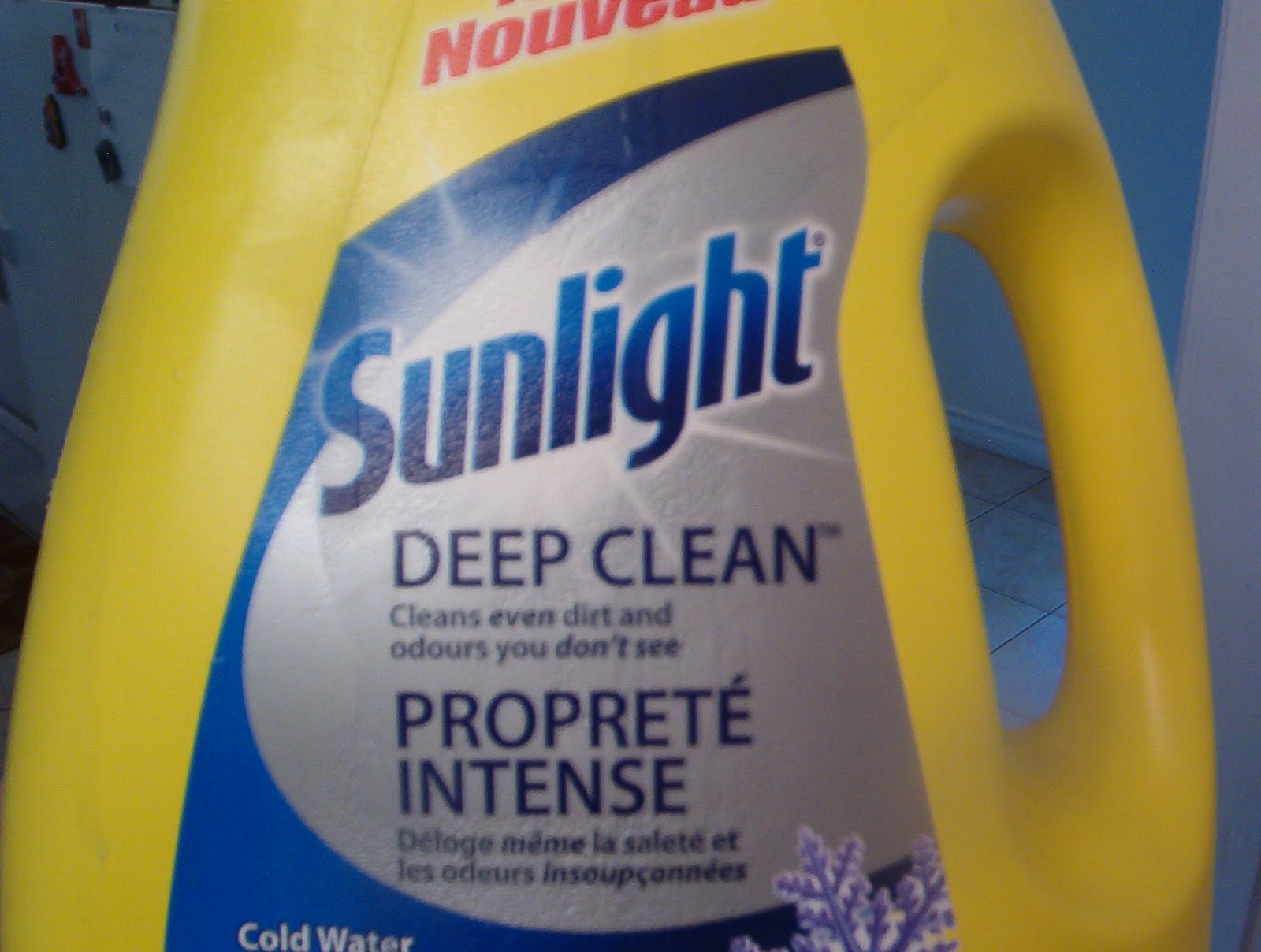
I was finally aroused from my reflective reverie when my eyes alighted on the label of the laundry detergent bottle:


"Cleans even dirt and odours you don't see." I could mention that you want a laundry detergent to clean clothes, not dirt. (Which begs the koan-like question: how does one know when one's dirt is clean?) But what really has me flummoxed is those odours I'm not seeing, which is a form of synesthesia I'm not familiar with. I don't think you can eyeball a stench. Although, I am freshly reminded, I can smell a scam.

Friday, September 03, 2010

Thursday, September 02, 2010

Let's See Pedro Proofread Like This

An unfinished (and seemingly unfinishable) living room flooring project, a dismantled malfunctioning washing machine, a power-washing young tradesman in wife-distracting muscle shirt blasting our siding and windows, and the plaintive pleas of a couple of whiny confined kids led us to flee our home today for lunch.

First stop was the gourmet meat store to pick up dinner goodies, where I ran into my favorite clerk: The Guy with the Low Threshold for Awe.

"Two chicken and two salmon kebabs? Awesome."

"Is that everything for you? Awesome."

"That'll be $10.96. From twenty? Awesome."

"Do you want a bag for that? No? Awesome."

Next stop, the local Taco Del Mar franchise for some semi-authentic Mexican grub. It's there, over a plate of well-sauced enchiladas, that I find this smörgÃ¥sbord of errata among the headlines on Page 6 of today's 24H:


Did you catch them? The first one is a simple typo; Hurricane Earl, the proper noun, is missing its proper capitalization. In the next one, the judge has in fact stepped down, as is made clear in the copy. "Steps away" makes it sound like he ducked out for a smoke. And finally, although it may sometimes seem like Prime Minister Stephen Harper is at war with himself, the PM and Harper can hardly be at odds over those jets, since Harper is the PM.

Anyway, enough of such frivolous nonsense. The transition stripping on the flooring awaits, as does the leaky washing machine, the now whiny and tired kids, and the re-positioning of the patio furniture that has been soaked by Pedro the sexy power-washer.

Awesome.

Tuesday, August 31, 2010

Caught at Sea

Seeing the ever-cheeky Ricky Gervais do his thing on the Emmy broadcast on the weekend reminded me of this bit of his. It's an entertaining example of how even just a slightly offbeat choice of word (in this case, caught) can cause a reader (in this case, the ever-cheeky Ricky Gervais) to make unintended (and in this case, delightfully whimsical) associations.

Friday, August 27, 2010

We Hold These Truths to be Self-Evident...


It appears the sign-writer grew weary of capitalization halfway through. 

Thursday, August 26, 2010

Sartorial Editorial

In the West End of Vancouver during the summer months, there are a number of impromptu street-corner "yard sales"--at least there used to be when I lived there. It was from one of these curbside vendors that I bought this distressed tank-top shirt many moons ago:


I remember standing there for several moments staring at the shirt displayed on the patch of grass just south of Davie Street, munching on my Sunday morning bagel, reading and re-reading the inscription. The daftly exuberant "A START!" The incongruous exhortation "THE GREAT THING TO MAKE" and the comprehensively incomprehensible "THE THAT IS THE 'ZONE.'" Evidently, someone had gone to the trouble of creating a passable graphic design and, with fearless chutzpah, produced god knows how many copies, without ever running the wording past a native English speaker. 

I clamped the remains of the bagel in my mouth, extracted a loonie from my pocket and passed it to the transvestite junkie proprietor of the roadside boutique. I have worn the shirt with equal measures of pride and recurring bemusement every summer since.

Sunday, August 22, 2010

Who is this Marshall, and What is his Law?

We watched "Me and Orson Welles" the other night, which means that, since picking up the DVD, I have been soulfully crooning the title to the tune of the 1972 infidelity ballad "Me and Mrs. Jones." Try it: Me-ee aa-and Orson, Orson Welles, Orson Welles, Orson Welles. We got a thing going on...

It's a wonderful little period piece about Welles's famed Mercury Theater production of "Julius Caesar" on Broadway in 1937--lots of fun, and Christian Mckay looks and sounds so much like a young Orson Welles it's downright eerie.

But let's look at the captioning for this scene, in which the Zac Efron character has accidentally triggered the fire sprinklers during final rehearsals, and Welles is exhorting his troops to respond...


In fact, of course, the mercurial (Mercury Theater. Mercurial. Get it?) director is invoking martial law and suspending the hell out of his people's habeas corpi. You could say the mishap was an example of Murphy's Law, except that Welles himself almost wishes it upon the production, because...well, you have to see the movie to get that.


Wednesday, August 18, 2010

Stalking the Wild Typo

I just saw this feature interview on Salon with one of the authors of The Great Typo Hunt, a book about a couple of buddies who cross the country meeting everyday Americans and pestering them about their spelling mistakes. The book is a synthesis of the blog posts they made during their travels. I don't know--a blog documenting other people's language errors? Seems like a waste of time to me.

The interview is not exactly the deep exploration of the laws of language and the perils of pedantry that it seems to aspire to (although I like the "hawks vs. hippies" vernacular the authors have come up with to describe the age-old prescriptivist/descriptivist dichotomy), but it is, after all, a transcription of a quickie phone conversation. It looks like the book may be worth a look-see.

Now for my own pedantic observation. At one point in the discussion, after the interviewee has described an encounter with someone who is less than appreciative of an unsolicited spelling intervention, the interviewer asks:
Why do you think so many people are so defensive about correcting their language?
I'm not saying there is an error there, since the question can be read in at least a couple of ways, but just to put too fine a point on it (and in the interests of finding a reason to mention this book here), I would say that the people in question are not so much defensive about correcting their language as they are defensive about having their language corrected, or being asked to correct it.

I know this from experience. Like the time I laughingly pointed out to my wife, Kim, that she had misspelled asparagus on the shopping list, and she laughingly kneed me in the groin.

Monday, August 16, 2010

Going the Extra Word

I'm not one of those strident Strunk & White purists (neither was White, for that matter) who believe that all good writing comes in spare, simple prose. There's plenty of room for more baroque styles of expression, if you ask me. But there is complex, playful or engaging wordiness, and then there is sloppy, banal prolixity. The important thing, as S&W command, is that "every word tell."

"Green in color," for instance, is always redundant, since something can't very well be green in height. And "different" is one of those words that always needs to be asked for its ID before gaining admittance to a sentence. Consider phrasings such as "I attended three different schools" and ask yourself what different brings to the party.

Today in Slate, I was checking out the recent TV Club Mad Men discussion, and came upon this sentence, describing the scene where Don's departing secretary heaves a paperweight at him:
But how cool would it have been if Don, ice water pumping through his veins, had unblinkingly caught the orb in his hand and gently placed it on the credenza?
I know these recaps are written, edited, and posted on the fly, so it's churlish to expect polished prose, but I can't help imagining how satisfying it would feel, as a copy editor, to drag a red pencil through "in his hand."

Meanwhile, over in another corner of Slate, advice columnist Prudence (yeah, like you don't read it, too) is dispensing counsel to a new husband who says that:
my wife was the DEFINITION of a bridezilla when planning out our wedding, and I felt bad for her attendants.
Unless there is an important difference between planning and planning out when it comes to weddings, that sentence would stand stronger if it were one word lighter. And yes, it should be badly, not bad, but let's leave that for another day. Poor guy has enough on his mind, what with having married an insufferable harpy.

Tuesday, August 10, 2010

Friendly Skies, Bitchy Tarmac

A frustrated JetBlue flight attendant allegedly fled his plane via emergency shoot -- beer in hand -- after getting into a fight with a passenger and then cursing out the entire cabin over a loudspeaker.
So begins a story about a skyhop getting into a dust-up with a passenger who got up to fetch something from the overhead bin while the aircraft was taxiing to the terminal (which, as anyone knows, is just asking for flight attendant jihad). The contretemps escalated and the attendant was bonked on the bean...
At that point, the flight attendant got on the loud speaker, told those aboard to "go f*** themselves," grabbed a beer from the galley, deployed the chute and ran into the terminal. 
Well. Someone's wound a little tight. Anyway, please return your seat to its upright position and note that the loudspeaker (as in, electronic communication device) in the first paragraph, becomes a loud speaker (as in, Rush Limbaugh) in the latter. Also, if we are going to use a direct quote, I'm guessing our spunky little steward told those aboard to "go f*** yourselves." And finally, of course, there is the matter of the getaway chute, which, in an amusing case of homonym befuddlement, is initially identified as an emergency shoot.

Andy Borowitz, by the way, has played off this story to great effect, with a faux news report entitled "All U.S. Workplaces to be Fitted with Inflatable Slides."

Monday, August 09, 2010

Advertising Age

I love looking through vintage magazines and papers, and I especially love browsing the old ads--fustily composed, epic-length come-ons for corn flakes and cigarettes, lavishly illustrated pages promoting remedies for ague and the grippe...and then there is this one, from a 1926 copy of MacLean's magazine I picked up in a quaint museum gift shop in the quaint town of Aggasiz:

In keeping with the purpose of this blog, I will force myself to point out that the phrase "the only pouch in the world which opens with a single sliding movement" assails my ear as a miscast restrictive use of the word which. (I know the Brits do it, but they drink weak tea with milk and kill each other over soccer games, too, so do we really need to take our lead from them?)  Anyway, I really just wanted to share this slice of life from a time when a zipper was considered the height of hi-tech wizardry.

And then there is this inventive re-imagining of modern social media, as portrayed in Mad Men-era ad style.


Again, I could get picky and point out that leasure should be leisure and that enchantment is not an adjective. But these faux ads were designed in Brazil so let's give them a pass on the English spelling and grammar and just enjoy the way they so deftly applied yesterday's advertising sensibilities to today's cultural touchstones.

Wednesday, August 04, 2010

Rules of Engagement

A happy day for the forces of moral progress. A federal judge in California decided that it wasn't OK after all for the majority to confiscate a civil right from a minority, and overturned the "Prop 8" ban on gay marriage (subject to further appeal, of course, but it's hard not to feel that the gay marriage genie is never going to go back into the tastefully-appointed bottle now).

In honor of the occasion, lefty blustermeister Keith Olbermann ended his show tonight with a rerun of his impassioned Special Comment (is there any other kind?) from November 2008, when the abominable Prop 8 passed. This site offers a video clip and transcript, from which I quote the following:

I keep hearing this term "re-defining" marriage. If this country hadn't re-defined marriage, black people still couldn't marry white people. Sixteen states had laws on the books which made that illegal in 1967. 1967.
The parents of the President-Elect of the United States couldn't have married in nearly one third of the states of the country their son grew up to lead. But it's worse than that. If this country had not "re-defined" marriage, some black people still couldn't marry black people. It is one of the most overlooked and cruelest parts of our sad story of slavery. Marriages were not legally recognized, if the people were slaves. Since slaves were property, they could not legally be husband and wife, or mother and child. Their marriage vows were different: not "Until Death, Do You Part," but "Until Death or Distance, Do You Part." Marriages among slaves were not legally recognized.
You know, just like marriages today in California are not legally recognized, if the people are gay.

It's well worth checking out, if only to see the sanctimonious Olbermann employing his best "how dare you, sir" sanctimony in the service of smiting an enemy that could use some sanctimonious sanctioning.

But in the heat of the moment, let's not overlook the nits that need picking. Standard matrimonial patter gives us the phrase, "until death do you part"--meaning, I'm quite sure, that death gets to do the parting of the happy couple. When you insert a comma to make it "Until Death, Do You Part"--as it is rendered in this transcript (with hysterical flourishes of capitalization, I might add)--it sounds like you, the couple, may now part...until death.

A minor quibble, I grant you. But as we're finding out, when it comes to defining marriage and its rules, details matter.

Monday, August 02, 2010

When Adjectives Attack

A couple of comically ambiguous meanings from yesterday's Province. First of all, this headline:

It's ok to shoot a serial offender dead (at least grammatically speaking--I won't make moral judgments here), but the intended adverbial sense of dead is easy to miss when the word is positioned like this. If you scan that headline and presume dead is performing its usual adjectival function, it sounds like the flatfoots where over-zealously perforating a corpse.

Elsewhere in the Sunday pages, in a story about how a local society of East Indian rationalists is offering  $100,000 to any soothsayers who can prove their ability to make accurate predictions, there is this sentence:
Astrologers, ghost-busters*, black magicians--whatever their specialty--are invited to answer 10 questions based on a person's janam kundli, or astrological birth chart.
Now, for all I know, it may well be that practitioners of black magic refer to themselves as "black magicians" (I really can't be bothered to look it up), but should we--and more importantly, should African-American conjurers in the white magic arts--really put up with that?

*I know what you're saying: shouldn't that be ghostbusters, as we all learned in the Ackroyd/Murray cinematic classic? According to Wikipedia, the movie was promoted as "Ghostbusters," yet titled on-screen as "Ghost Busters." So I guess the ghost-busting community is kind of open on this one.